Showing posts with label digital natives. Show all posts

Sunday, January 10, 2010

Where next for Digital Identity?


Identity and privacy have recently rarely been out of the headlines.
No dia 07 de Janeiro 2010 teve lugar a conferência "Where next for Digital Identity?" organizada por Eduserv - Innovative Technologie Services.

O evento decorreu numa das salas do Centro de Conferências da British Library e contou com a presença de cerca de quarenta especialistas, professores e pesquisadores do Reino Unido. Como outsider, isto é, não anglo-saxónica, apenas eu!


Eduserv funded three projects on Digital Identity as a result of our 2008 Eduserv Foundation grants call. The aim of this event is to share the findings from those projects and to analyse the key issues that they have identified in more detail. It will also provide an opportunity for discussion about the impact of social software and new media on future trends in this area. The intention is to focus primarily on the social, rather than technical, aspects of digital identity.

Delegates will have a chance to hear about and discuss differing conceptualisations of digital identity and leave with a better understanding of the relevance of digital identity to teaching, learning, research and related activities.

wn4di.eventbrite.com

Numa altura em que se começa, finalmente, a debater com preocupação, a "Identidade Digital",  dada a proliferação do aproveitamento dos dados pessoais , por questões políticas, de segurança, ou por questões comerciais, debates como este são muito importantes! 
Certo é que a maior parte das pessoas não se importa e até providencia, de bom grado, a sua identidade, segundo um recente relatório. UK Information Commissioner caracterizou a situação, apelidando-a de "Sleepwalking into a Surveillance Society".

O primeiro orador  convidado Dr Ian Brown do Oxford Internet Institute, fez uma apresentação muito interessante denominada  Controlling Digital Identity que poderá ser vista aqui 

Seguiram-se, Steven Warburton, do King's College London, com a apresentação do projecto "Rhizome: Design Patterns for Digital Identity", que providenciará aos utilizadores da Internet  e redes sociais um conjunto de ferramentas e práticas para criar e controlar efectivamente os seus dados pessoais online. 

Shirley Williams, "This is Me: Exploring Digital Identity" da University of Reading, e Harry Halpin, da University of Edinburgh "Creating a W3C standard for opening social networking data". Houve uma áudio participação intermédia entre este dois últimos.

A intervenção de Ian Brown, agora lida, interessa-me profundamente não só como investigadora, professora avaliadora de Conteúdos Educativos Digitais e Recursos Educativos Informatizados, como também, cidadã e utilizadora da Internet. Seguirei com atenção este trabalho.
Na sequência, entendi melhor os objectivos da apresentação de Steve Wartburton. Não pudera ouvir Ian Brown pelo facto de ter ficado retida nos aeroportos devido a condições climatéricas.

Dada a área em que trabalho e me movo, considerei o tema apresentado por Shirley Williams muito apelativo. Ela deteve-se sobre os riscos que crianças e adolescentes correm ao publicar, partilhar, dados pessoais e fotografias nas redes sociais.

É verdade que uma maioria dos internautas adolescentes, alguns em idade pré-adolescente não tem a noção de vida privada! Papel importante a desempenhar por Professores e Pais. Alertar para todo o tipo de riscos que correm.

"Impudiques, voire exhibitionnistes, ils ne feraient plus la différence entre vie publique et vie privée."

Mark Zucerberg, fundador de Facebook afirmou, por sua vez,  perante uma plateia ao vivo, ontem, 09 Janeiro, que  se voltasse a criar Facebook, as informações sobre os utilizadores seriam "por defeito" públicas e não privadas, como foram durante anos, até à alteração dramática efectuada em Dezembro.

Pensar no número, impossível de contabilizar, de pré-adolescentes, adolescentes, pais e famílias que partilham toda a sua "privacidade" nesta rede social, torna-se assustador.

Daí que considere que todas as estas discussões e debates sejam de extrema importância para criar uma "nova cultura" da utilização da Internet!

A parte da tarde foi ocupada por um workshop: "breakout groups" debateram algumas propostas relacionadas com a identidade digital.

No que me concerne, teria sido proveitosa, nesta parte, uma pequena introdução entre elementos do mesmo grupo. Seria muito indelicado da minha parte cortar a dinâmica do grupo, apenas para perguntar a identificação das pessoas com quem partilhei a mesa.

Andy Powell, da Eduserv, foi o dinamizador desta conferência.


On 07 January 2010 tooked place the conference "Where next for Digital Identity?" organized by Eduserv - Innovative Technologie Services, and hosted at the Conference Center of the British Library. It  was attended by about forty specialists, professors and researchers from the United Kingdom. The unique 'outsider': me!

When we begin, finally, discussing with concern the "Digital Identity", given the proliferation of the use of personal data for political, security, or commercial reasons, discussions like that one are very important! It is almost certain that citizen, in generally, support identification and surveillance, according to a recent report. UK Information Commissioner characterized the situation, calling it "Sleepwalking into a Surveillance Society".

The first invited speaker, Dr Ian Brown, Oxford Internet Institute, presented "Controlling Digital"! Very interesting! The slides can be seen here

Followed by Steven Warburton, King's College London, who presented the project "Rhizome: Design Patterns for Digital Identity", which "individual can be provided with a set of tools and pratices that will allow them to create and control effective online identities". It would be quite useful, but I wonder...

Shirley Williams, "This is Me: Exploring Digital Identity", University of Reading, and finally Harry Halpin, University of Edinburgh "Creating a W3C standard for social networking opening date." There was an audio participation between these two.

The presentation of Ian Brown, deeply interesting to me, not only as an individual researcher in Educational Technologies, and a teacher assessor in Educational Computerized Resources, but also as a citizen and as an user of the Internet. I will be in touch with this research work, certainly.
Knowing now his speech, I better understand the objectives of the presentation by Steve Wartburton. I could not listen Ian Brown because I have been kept at airports by weather conditions.

My area of research and interests is "Youth and Internet". So, I considered the presentation by Shirley Williams very appealing. She spoked about the risks  of children and adolescents publishing, sharing, personal data and photos in social networks.

It's true that the majority of young people have not the notion of privacy! Here one of the importants role of teaching in 21st century: alert the students to all kinds of risks they face. Parents' role is also very important.

"Impudiques, voire exhibitionnistes, ils ne feraient plus la différence entre vie publique et vie privée."

"Facebook founder Mark Zuckerberg told a live audience yesterday that if he were to create Facebook again today, user information would by default be public, not private as it was for years until the company changed dramatically in December."


The afternoon session has been practical and interactive. "Breakout groups " discussed some proposals related to digital identity.

For me, it would be very useful, a short introduction of group elements. It would be very rude of me if I cut the group dynamics, just to have a curious look for ID. 
But I get out more enriched! And that's matter!


Andy Powell, Eduserv, made the introductions, welcome and closing plenary.


I'm sure that those kind of discussions and debates are very important and it will help to create a "new culture" for using Internet! 

Internet opened new routes for Education! That's wonderful! Internet is well used by net-generation and teachers also for education and learning purposes, often outside the class.  
Students need to know how apply skills by thinking critically.


"Please come expecting to help shape the future!" I did it... on my way!

G-Souto
11.01.2010

Copyright © 2010G-Souto'sBlog, gsouto-digitalteacher.blogspot.com®


References

Privacy Value Networks


    Wednesday, September 30, 2009

    New Millenium Learners Conference


    The OECD’s Centre for Educational Research and Innovation (CERI) launched the New Millennium Learners (NML) project in 2007. It has the global aim of investigating the effects of digital technologies on school-age learners and providing recommendations on the most appropriate institutional and policy responses from the education sector.

    NML


    Andreas Schleicher/ OECDICT and Education
    http://www.nml-conference.be/

    O conceito de New Millenium Learners sugere que a adopção das Tecnologias particularmente pelas novas gerações - os nativos digitais - tem uma presença forte na construção da sua identidade, no modo como comunicam socialmente em rede, e como administram a informação e o conhecimento.

    The concept of New Millennium Learners suggests that technology uptake, particularly by younger generations, has an effect on the way people build their identities, communicate socially, and manage information and knowledge.


    Roundtable chair Frances Kelly/ Educational Counsellor

    http://www.nml-conference.be/

    Durante três intensos dias de trabalho, investigadores de trinta países espalhados pelos vários continentes, apresentaram perspectivas desse impacto na Educação dos adolescentes Millenium.

    No final de cada sessão foram apresentados vídeos com testemunhos de estudantes de uma escola secundária da Flandres, que demonstraram bem como o papel dos professores inovadores é importante no seu percurso escolar.

    As chamadas competências do século XXI foram portanto o tema centralizador da Conferência. O consenso foi geral! A definição de aprendizagens e competências a serem exigidas aos jovens estudantes, de modo a tornarem-se futuros profissionais de qualidade e cidadãos responsáveis, é urgente.

    These so-called 21st Century Competencies, which are the main topic of this conference, cover the range of skills and competencies that young people will be required to have in order to be effective workers and responsible citizens in the knowledge society of the 21st century.

    Definiram-se várias estratégias, que passam pela transversalidade das Tecnologias e de temas de Cidadania em todos as áreas curriculares, pelo que áreas como Informática e Educação Cívica não terão mais razão de existir. Também são aconselháveis a modernização de alguns currículos escolares. 

    A responsabilização das escolas na formação dos seus professores, e  consequente actualização dos mesmos, serão metas a atingir com carácter obrigatório. 
    No penúltimo dia foi oferecido aos conferencistas e participantes um jantar de confraternização no 30º andar de um edifício, com uma  soberba panorâmica sobre uma grande parte da cidade de Bruxelas, num final de tarde com um pôr-do-sol esplendoroso. 

    Saí mais enriquecida no final deste diálogo internacional! O projecto NML será um êxito se todos nos empenharmos nas novas tendências e objectivos da Educação, neste século XXI.


    Dr Francesc Pedró OECD/CERI

    100 researchers, teachers and organisations from 30 countries participated in the  New Millenium Learners Conference, Brussels, Belgium, 21-23 September 2009.

    Micheline Scheys who manages the interface project between education and labour policy within the Flemish Ministry of Education and Training in Belgium has been an unique  hostess of NML Conference.

    All the sessions taked place in  the Auditorium of the Conscience Building. The first NML Conference aimed at showcasing the results of the first phase  to link them to the next.
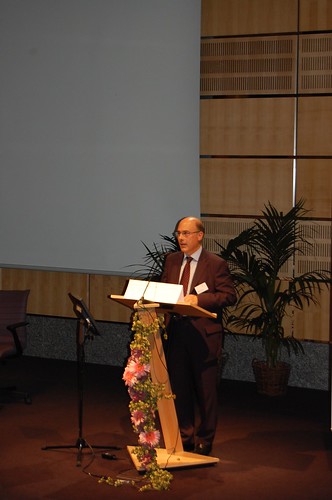
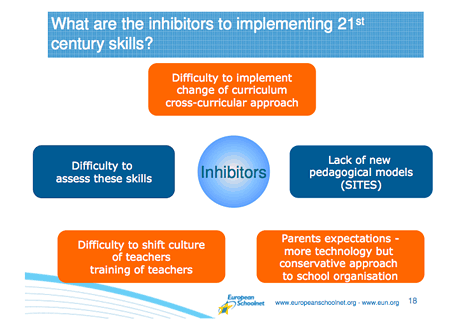
    Many orators presented their overview about changing policies and programs. This slide from Marc Durando of the European Schoolnet succinctly captures the inhibitors to implementing such policies and programs.


    Marc Durando/ European Schoolnet

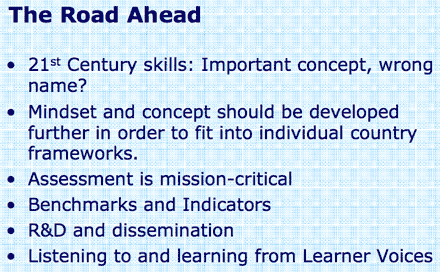
    Finland is a nation that has been very successful in raising education performance. The “Road Ahead” provided by Oystein Johannessen could be useful.  Mr Johannessen is the Deputy Director General from the Norwegian Ministry of Education and Research about to begin a secondment to the OECD’s Centre for Educational Research and Innovation (CERI).


    Oystein Joahnnssen/Deputy General, NME*

    For three days, researchers presented their investigations and opened an interesting debate with all participants, sharing ideas and experiences about "the range of skills and competencies that young students will be required to have in the knowledge society of the 21st Century".


    Dirk Van Damme/Head of the CERI*

    The last day, Anthony Mackay conference rapporteur made the final report  with some key-notes and Dirk Van Damme, head of CERI, presented general conclusions, mentioned the Global Financial Crisis.

    This ongoing event highlights the need to prepare students for an unknown future where the only certainty is change and the most successful people will be able to analyze what’s happening and to make choices that support their own and their community’s welfare.  This brings to clear focus the difference between ICT Literacy /  “High Tech job prep” and 21st Century Skills.

    Dirk Van Damme

    Between all sessions, some videos with students' voices from the Provinciale Secundaire School Diepenbeek had been presented. It's always very interesting to know the expression of the students about their teachers, learning, e-skills, and Internet use, in school and at home.

    All the research outcomes or policy initiaves in the area can only be put in practice if teachers and students regard them as valuable and relevant to their teaching and learning experience.

    NML country survey

    I think, most of  all, as a researcher teacher and an e-facilitator, that young people brought a fantastic new vision to schools and Education with their visual spatial skills, non verbal intelligence, multi-tasking attitude, in classroom.

    As a "pioneer native" teacher and author, I create some educational digital resources as cross-curricular competencies, increasing skills and competencies of my students, motivating them to go further "in order to be effective workers and responsible citizens in the knowledge society of the 21st century".

    A fruitful and instructive conference!


    G-Souto
    01.10.2009
    Copyright © 2010G-Souto'sBlog, gsouto-digitalteacher.blogspot.com®

    Creative Commons License
    Esta obra está licenciada sob uma Licença Creative Commons.


    Reference: Slides from Tom March's site.


    Thanks:

    Micheline Scheys
    Flemish Ministry of Education
    OECD/CERI


    Sarina De Rijbel [Secretariat]

    Sunday, September 6, 2009

    Digital schools versus digital teachers


    John Palfrey/ Hanser
    Today's students – K through college – represent the first generations to grow up with this new technology. They have spent their entire lives surrounded by and using computers, videogames, digital music players, video cams, cell phones, and all the other toys and tools of the digital age.

    Marc Prensky, 2001

    Children and adolescents in digital societies are growing up in a world where digital technologies are ubiquitous.
    Internet is used by net-generation also for education and learning purposes, often outside the classroom.
    This emergence of digital native learners has major potential implications for Education.

    Games and Digital Resources in School is an important and serious goal in the 21st century focus on the changing face of Education.

    I am a "digital pioneer" teacher. I can not be called a "digital immigrant" . I did not grow up with Technology. It grew up with me, and I was there every step of the way. A "digital pioneer" who is doing a enthousiastic job infusing technology meaningfully into teaching and learning.

    I am a tech researcher and a learning author for quite a time! After previewing the digital resource, created by myself or not, I put it in context phase, that means in the classroom and outside classroom (formal and informal learning), observing my own students, as they interact with the digital resources selected.

    The selection must be the most desirable in terms of educational objectives and constraints.

    I could feel the enthousiasm of the "N-Gen", when the Web 2.0 entered into my school time as being part of curricula.

    I teach on formal (face-to-face teaching) and informal learning (web 2.0). Never missing a new way or option to use digital resources in Education. 
    My students can reach me by email, on Messenger since 1999, text cell phone, blogs or moodle plataform since 2002. 

    As an tech-savvy educator, I am teaching to the current generation of digital natives in ways that support these students varied learning styles.
    .
    Rick Wilking/ Reuters 2009

    Reseachers and teachers recognise that learning is ongoing and seeks to provide digital resources of quality to support learning on schools.

    The assessment of these new tools and devices in curricula is crucial! These digital resources must be certified by experts in IT & Education who have the knowledge of school curricula contents .

    The feed-back of experimentation done by teachers and students have an enormous impact.

    The objective of the assessment is to analyse the N-Gen - "new learning generation" in classroom and outside classroom, understand their expectations and attitudes facing the "new ways of learning", using digital resources.
    Expert teachers must analyse needs and goals carefully, specify the requirements, and finally, test digital resources in classroom, with different students.

    Digital resources, games, virtual worlds used in Education, after being analized and tested in real contexts, could join a kind of repository for teachers, parents, and students.

    Something is already done by Merlot (Multimedia Educational Resource for Learning and Online Teaching).


    Also European Schoolnet in cooperation with the International Software Federation of Europe (ISFE) organised too an European Conference on the use of electronic games in schools on 5 May 2009 in Strasbourg, France.

    gis_small013.jpg


    Conference "Games on Schools

    John Dowell (University College London) concluded by raising the point that some argue from generation to generation that our intelligence is evolving2) and indeed rising. If this is true, intelligence is also evolving into different forms, such as games and may even be driven by this kind of popular culture.


    Well, "Digital games in schools" has been published with the support of the Interactive Software Federation of Europe:


    Written by Dr Patrick Felicia, a researcher at the Waterford Institute of Technology in Ireland, the handbook is intended for teachers interested in using digital games in their lessons. It provides the necessary information to understand the educational benefits of digital games and to learn how to use them as educational and motivational resources. The handbook is available in digital version below and can be ordered in print against a small fee to cover shipping cost

    The Games in Schools Community of Practice report is now available in PDF (english version) here

    I'ts a very good step on this long way from good pratical examples!

    Should we create a parallel curriculum for 21st century learning? Games can surely contribute. Perhaps on EU level, we need to build such a curriculum?

    John Dowell

    I don't know if we must create a parallel curriculum! I think it's very important create new curricula crossing traditional pedagogy and digital tools for digital natives if we want keep them focus on school time!

    The impact of Digital Resources on cognitive skills and on learning expectations and the evolution of social values and lifestyles are important issues.

    G-Souto
    07.09.2009
    Copyright © 2010G-Souto'sBlog, gsouto-digitalteacher.blogspot.com®


    References:

    Prensky, Marc, Digital Natives, Digital Immigrants, on Horiozon (MCB University Press, Vol. 9 No. 5, October 2001

    Souto, G., Assessment of Digital Resources use in Education, Anatomy of Digital Resources in Learning Generation, Research, Reflections and Innovations in Integrating ICT in Education, Vol. 2, Formatex, Spain, April 2009

    Palfrey, John, Publications
    http://blogs.law.harvard.edu/palfrey/top/publications/

    Games in Schools, European Scholnet, ISFE
    http://games.eun.org/